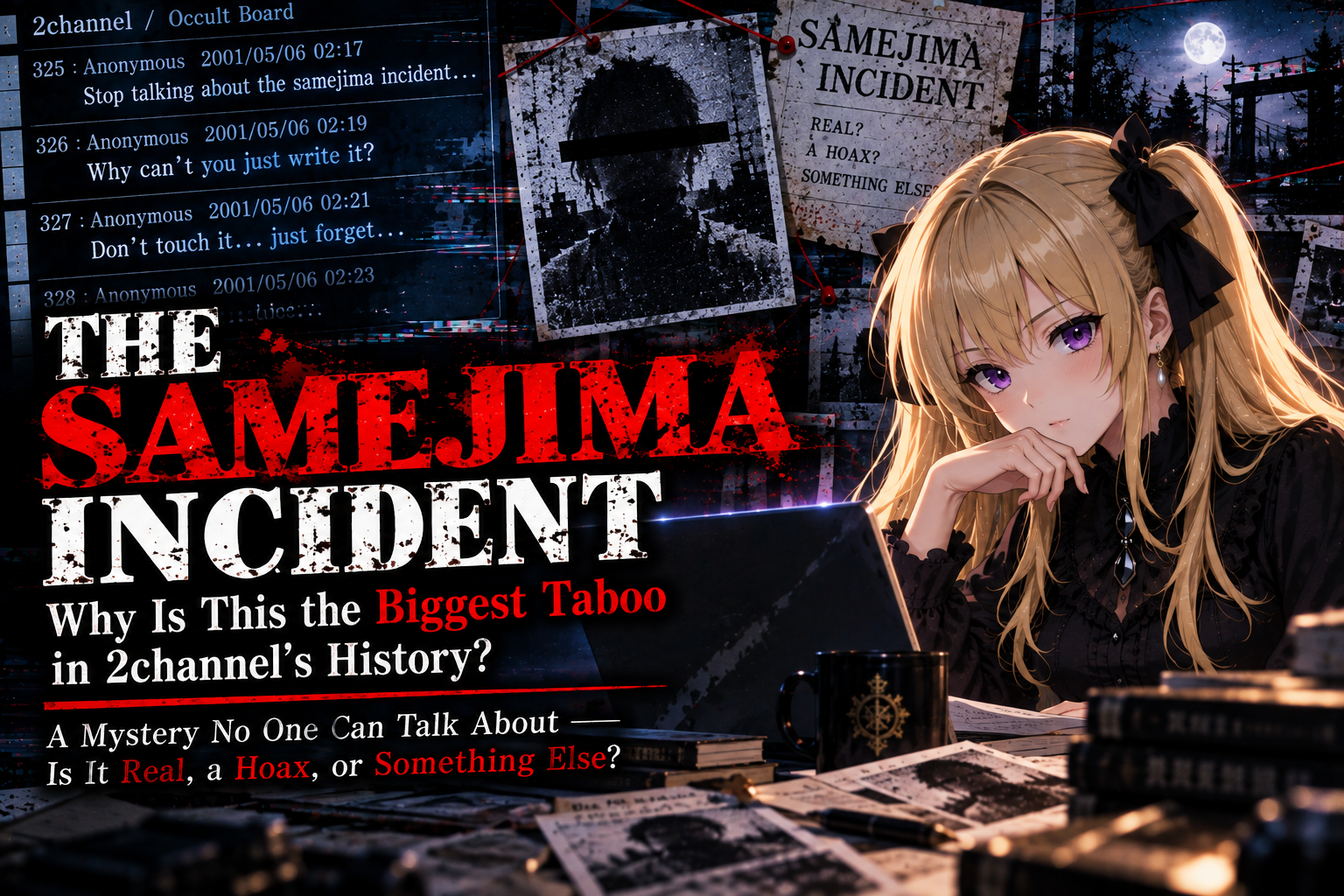
♫ IRIS Night File
May 24, 2001.
An anonymous internet forum.
A mysterious incident that nobody was willing to explain.
Play the soundtrack and open tonight’s investigation.
I am Iris.
Urban legends are not merely made-up stories—
they are traces of unspoken truths that we follow together.
The Incident Nobody Was Allowed to Discuss
Have you ever heard of the Samejima Incident?
In Japan, the name has circulated through internet forums for more than twenty years.
It is supposedly one of the most disturbing incidents in the history of 2channel, Japan’s influential anonymous discussion board.
People claimed that discussing it was dangerous.
Others warned that government authorities were involved.
Some suggested that evidence had been erased.
And whenever someone asked what actually happened, the response was usually the same.
Do not talk about it.
Do not ask.
Forget what you have heard.
But there is something strange about the story.
Nobody seems able to explain the incident itself.
Who was involved?
Where did it happen?
When did it happen?
What exactly occurred?
The answers change depending on who tells the story.
Some versions involve a violent assault.
Others describe missing people.
Some suggest secret government involvement.
Yet the oldest surviving discussion begins without explaining any of those events.
And five days after that discussion began, someone appeared claiming that the entire story had been invented.
Tonight, we investigate the Samejima Incident through the original Japanese forum records.
Because the real mystery may not be what happened.
It may be how so many people came to act as if something had happened.
Chapter One | Japan’s Anonymous Internet Culture
To understand the Samejima Incident, we first need to understand 2channel.
Known as 2ch, it was a major Japanese text-based discussion forum.
Launched in 1999, the website became known for its anonymous discussions, jokes, rumors, arguments, and unusual internet folklore.
Users could post without revealing their real identities.
A conversation might contain dozens of comments, but those comments did not necessarily represent dozens of different people.
Someone could invent a story.
Another person could challenge it.
Several others could pretend to know more than they revealed.
The forum’s structure made these exchanges unusually easy.
The Samejima Incident emerged from that environment.
But contrary to a common assumption, the earliest identifiable thread did not originate on 2channel’s paranormal board.
It appeared on the Lounge board.
That distinction is important because the Lounge board was associated with casual conversation, humor, and playful interaction.
And the earliest Samejima discussion contains unmistakable signs of that culture.
Chapter Two | May 24, 2001
The earliest identifiable thread began on May 24, 2001.
The time was 10:56 p.m.
Its Japanese title was:
“Let’s Talk About the Legendary Samejima Thread.”
The opening post claimed that an older Samejima discussion had already become legendary among users of the Lounge board.
The writer described having been deeply affected by it.
Then the writer asked whether anyone had saved the original thread.
This was an unusual beginning.
The post did not describe a murder.
It did not describe a disappearance.
It did not identify a crime scene.
It did not provide a victim’s name.
Instead, it assumed that a mysterious earlier event was already famous.
The reader was placed in an uncomfortable position.
Apparently, something important had happened.
Other people were supposed to know about it.
But the reader did not.
That feeling of missing information became central to the legend.
Chapter Three | The Taboo Appeared Almost Immediately
The first replies arrived within minutes.
One user simply asked what the story was about.
Then, at 10:57 p.m., another participant treated the subject as forbidden.
Additional replies suggested that the earlier discussion was disturbing and should not be mentioned.
By 11:03 p.m., a participant was describing the subject as something that everyone knew but deliberately avoided discussing.
The remarkable part is how quickly this atmosphere appeared.
There was no documented investigation.
No official report.
No verifiable victim.
No explanation of the supposed event.
Yet the discussion already contained warnings, discomfort, and claims of shared knowledge.
This is the crucial mechanism of the Samejima Incident.
The appearance of collective knowledge existed before the audience received any actual knowledge.
The participants seemed to know something.
And the absence of an explanation made that impression stronger.
Chapter Four | A Mystery Built Around an Empty Center
Most horror stories describe something frightening.
A ghost appears.
A person disappears.
An abandoned building contains a strange presence.
An ordinary location becomes dangerous.
The reader imagines the event.
But Samejima works differently.
The frightening event is never clearly described.
Instead, the reader encounters the reactions of other people.
They appear alarmed.
They refuse to explain.
They warn the curious to stop asking questions.
That refusal becomes the story.
This resembles the structure of a forbidden tale.
The audience is told that a terrible story exists, but the story itself is never disclosed.
As a result, the reader is invited to imagine something worse than any specific description.
The lack of information is not a weakness of the legend.
It is the feature that makes the legend work.
Chapter Five | Some Users Suspected a Joke From the Beginning
An important detail is often overlooked.
Not everyone in the original discussion appeared to believe the story.
The archived May 24 thread contains skeptical reactions almost immediately.
One participant suggested that the supposed earlier discussion had already been regarded as a joke.
Others asked for evidence.
Some questioned whether the legendary thread existed at all.
By the end of the discussion, several participants were openly treating Samejima as a fabricated topic.
That matters because later retellings sometimes create the impression that an entire online community was terrified by a real mystery.
The contemporary record suggests something more complicated.
Some people played along.
Some asked genuine questions.
Some challenged the premise.
Others openly treated the discussion as entertainment.
The Samejima Incident developed through these competing reactions.
Chapter Six | The Same Identification Appeared Twice
Now we reach one of the most revealing details in the original archive.
The opening post was associated with this user ID:
yWtu.nZk
Several minutes later, post number 16 appeared.
That post used exactly the same ID.
But it presented itself as a reply from another participant.
The writer used the name of post number 8, a person who had been asking for an explanation of the mysterious event.
In other words, the same visible identifier appeared behind two different conversational roles.
One voice presented itself as someone familiar with the legendary thread.
Another appeared to ask questions as though it knew very little.
This does not prove the real-world identity of the writer.
Nor does it prove that every suspicious reply came from one individual.
But it is a concrete indication that at least some of the apparent conversation may have been deliberately staged.
And five days later, someone explicitly pointed to this detail.
Chapter Seven | The Confession of May 29
On May 29, 2001, another thread appeared on the Lounge board.
Its title was:
“The Truth About the Samejima Thread.”
The poster used the name Dory.
At 1:21 a.m., Dory claimed to have started the original discussion.
The following posts described the entire affair as a joke.
Dory also claimed to have written many of the early replies.
Then came a particularly interesting statement.
Readers were told to compare the user IDs of posts 1 and 16 in the original thread.
When those posts are checked, the IDs do match.
That is an independently verifiable detail within the surviving forum records.
However, a limitation remains.
Dory’s real identity has not been independently established.
The ID used in the confession is not the same as the ID appearing in the original discussion five days earlier.
Therefore, the confession cannot by itself prove that Dory was the original poster.
Nor can it prove that every early message attributed to one person was actually written by that person.
Nevertheless, the confession accurately identifies a suspicious feature of the earlier record.
That gives it evidentiary value beyond a vague claim that the story was fabricated.
Chapter Eight | How the Rumor Expanded
As the discussion continued, the name Samejima began appearing in other threads and on other boards.
New details emerged.
Some users mentioned Japanese public security authorities.
Others suggested that people had gathered near Kashiwa Station.
There were claims that information had been removed.
There were references to unnamed victims and people who supposedly knew what had happened.
But these details were not accompanied by reliable independent evidence.
The important development was the multiplication of stories.
A reference in one discussion could be repeated in another.
Someone could add another detail.
A later reader might encounter several threads mentioning the same mysterious event.
To that reader, the repetition could appear to be corroboration.
But repeated claims are not necessarily independent evidence.
Several posts may simply be repeating or elaborating on the same original rumor.
That distinction remains important in today’s information environment.
Chapter Nine | Was the Japanese Government Involved?
One of the enduring claims about Samejima is that Japanese authorities concealed the incident.
Some versions refer to public security police.
Others suggest that posts were deleted or that witnesses were silenced.
Such claims are part of the legend.
But a historical investigation requires more.
An identifiable event.
A date.
A location.
People involved.
Evidence of an investigation.
Records connecting specific officials to an alleged suppression of information.
The early Samejima material does not establish those elements.
There are genuine historical examples of government secrecy and misconduct.
But the existence of real cover-ups elsewhere does not establish a cover-up here.
We must distinguish two very different statements.
“Some online users claimed that information was being suppressed.”
And:
“Government authorities actually suppressed information.”
The first statement is supported by archived discussion.
The second has not been established by the evidence reviewed for this article.
The difference is fundamental.
Chapter Ten | Many Different Versions of the Same Story
Over time, Samejima acquired numerous supposed explanations.
A group assault involving online users.
A set of disturbing photographs.
A disappearance on a remote island.
A secret investigation.
A conflict among forum participants.
These versions differ substantially.
Some involve different locations.
Others describe different victims or entirely different circumstances.
This is difficult to reconcile with the idea of a single, clearly documented incident.
The original May 24 discussion also contains no detailed narrative establishing any one of these later stories.
A more plausible interpretation is that the legend’s original lack of detail created room for many different additions.
The name remained the same.
The story underneath it changed.
That is a defining characteristic of internet folklore.
Chapter Eleven | A Legend That Became a Movie
The Samejima Incident eventually reached the film industry.
In November 2020, the Japanese horror film Shin Samejima Jiken was released.
Its English title is The Samejima Incident.
The film used the mythology of a forbidden internet incident as the basis for a fictional horror story.
This is a striking development.
The original online discussion provided almost no verifiable details of a real crime.
Yet the name and its surrounding mythology became recognizable enough to support a commercial film.
That does not make the alleged event real.
It demonstrates something else.
A fictional or unverified story can become a real cultural phenomenon.
It can influence books, films, online discussions, and the memories of an internet generation.
Chapter Twelve | Yesterday’s Kurashiki Mystery and Today’s Samejima Incident
The Samejima Incident becomes even more interesting when compared with another Japanese internet mystery.
Yesterday, we investigated the Kurashiki Manhole Incident of 2004.
That story began with an alleged disappearance and an unexplained underground entrance.
Forum users reported traveling to real locations.
Photographs were posted.
Searches continued.
The location of a mysterious photographed cover was eventually associated with Fukuyama, Hiroshima Prefecture.
The original disappearance remained unverified.
Samejima developed differently.
There was no clear crime scene to investigate.
No identifiable victim.
No consistent description of the supposed incident.
Instead, the community created an atmosphere of shared knowledge and taboo.
The contrast is revealing.
Kurashiki shows how an online story can influence reported real-world behavior.
Samejima shows how an online story can influence collective perception.
Both demonstrate that internet folklore is shaped not only by the original claim, but also by the behavior of the audience.
Chapter Thirteen | Why the Legend Still Matters in 2026
The original Samejima discussion began twenty-five years ago.
Today’s internet is technologically very different.
Social-media accounts can reach vast audiences.
Automated systems can produce posts at scale.
Generative AI can create plausible text, images, and synthetic conversations.
But one fundamental problem has not changed.
Several messages do not necessarily represent several independent sources.
A claim repeated by many accounts does not automatically become true.
And a person who appears to know a secret may simply be performing the role of an insider.
The archived Samejima posts provide a surprisingly modern lesson.
Ask where the claim began.
Compare the original records.
Check whether supposedly different voices are genuinely independent.
Separate statements about an event from evidence that the event occurred.
And never confuse the absence of information with proof that information was deliberately concealed.
Final Chapter | The True Meaning of the Samejima Incident
What was the Samejima Incident?
The earliest identifiable discussion began on May 24, 2001.
It referred to an allegedly legendary earlier thread.
But the actual event remained undefined.
Participants quickly treated the subject as dangerous.
Others questioned the story.
The original archive reveals that posts 1 and 16 shared the same user ID.
Five days later, Dory claimed that the discussion had been fabricated and directed readers to that matching ID.
That confession cannot be fully authenticated.
But its specific observation is supported by the original record.
Meanwhile, no independent evidence has been established for the violent crimes, disappearances, or government cover-ups later associated with the name.
The available record therefore points toward an unusual conclusion.
Samejima was not primarily a story about a documented event that people refused to discuss.
It was a story sustained by people acting as if such an event had already occurred.
And perhaps that is why it survived.
There was no definitive narrative to disprove.
No fixed ending.
No single location.
No consistent list of victims.
Only an ominous name and a community willing to keep the mystery alive.
The original discussion may have been a joke.
But its cultural consequences were real.
It became part of Japanese internet folklore.
It inspired later stories.
It became the basis of a horror film.
And it remains recognizable more than two decades later.
Perhaps the most unsettling question is not what happened in the Samejima Incident.
Perhaps it is this:
How many people need to behave as though something is true before others begin to experience it as reality?
That question belongs not only to the internet of 2001.
It belongs to ours.
Let us keep looking for the fragments of truth.
I will return to continue the telling.
Primary Records & References
The investigation prioritizes surviving 2001 forum records over later retellings. Archived comments establish what users wrote, not necessarily whether the events they described actually happened.
Source: 2channel Lounge Board / 5channel Archive
Used to verify the original thread, early taboo warnings, skepticism, and the identical user IDs associated with posts 1 and 16.
▶ Read the Original ArchiveSource: 2channel Lounge Board / Wayback Machine
A user named Dory claimed to have invented the discussion, described early self-posting, and identified the matching IDs of posts 1 and 16. The author’s identity remains independently unverified.
▶ Read the Confession ArchiveSource: Archived 2channel Discussion / Wayback Machine
Used to examine the spread of claims involving public security authorities, Kashiwa Station, and alleged missing information.
▶ Read the Related DiscussionSource: Ghost in the Head / Secondary Research
Used for contextual comparison between the earliest forum posts, the May 29 confession, and later versions of the legend.
▶ Read the Japanese InvestigationSource: Japanese Film Database
Official film information documenting the cultural transformation of the internet legend into a commercial horror production.
▶ View the Film RecordPosting Time
October 19, 2026 | 23:00 JST
English Edition | Secretary Iris’s Urban Legend Notebook
♫ IRIS FILE — Official Theme Song
Every investigation begins with a question: Is it really true?
Related Reading
▶ Why Do Urban Legends Never Disappear? — One Year of Secretary Iris’s Notebook
▶ Does the Necronomicon Really Exist? — How Fiction Became a “Real” Forbidden Book
▶ Can You Really “See” It? — Why Ghost Photos Look Different to Different People
▶ Why Are Mirrors and Facing Mirrors So Unsettling? — Reflections and Boundary Legends
Share Your Urban Legend
Do you remember a mysterious internet discussion, a forgotten forum legend, or an unexplained event?
Send your story or research lead to Iris.